Midnight Burnout: When You Hold It Together All Day and Fall Apart at Night
If your days look functional but your nights feel like collapse, midnight burnout may be your nervous system finally asking to be heard.
By 6pm, you look fine.
You answered the emails. Joined the meetings. Smiled in the kitchen. Helped whoever needed you. Maybe you even sounded calm.
It is only when the house goes quiet, the lights dim, and you are finally alone with yourself that everything catches up.
Your heart speeds up for no obvious reason. Your mind starts replaying every unfinished task, every near miss, every "what if?". Sleep feels very far away.
If your days look functional and your nights feel like collapse, you are not broken.
You may be experiencing a kind of midnight burnout: the version of burnout that does not always show up on performance reviews, family calendars, or polite conversations, but your body knows exactly how real it is.
Short answer: midnight burnout is what can happen when you spend the day in hold-it-together mode and your nervous system only gets space to release the pressure at night. Tonight, the goal is not to solve your whole life. It is to lower the alarm enough to get through this hour more safely and kindly.
What midnight burnout really is
Midnight burnout is not just "thinking too much at night".
It is what happens when your nervous system spends most of the day performing competence: working, caring, coping, explaining, smiling, producing, staying useful.
Then the noise stops.
No one needs anything from you for five minutes.
And the part of you that has been holding its breath all day finally gets a chance to speak.
Sleep Foundation notes that anxiety can feel worse at night because daytime distractions fade and the mind has more space to focus on worries. It also describes nighttime anxiety as something that can interfere with falling asleep or staying asleep, especially when stress, trauma, insomnia, or persistent worry are already in the system.
That is the collision point.
A life that looks fine from the outside.
A body that knows it has been carrying too much for too long.
Signs you might be in midnight burnout
Everyone's nights look different, but these patterns show up often:
- You lie down and your mind immediately starts racing through tasks, conversations, worst-case scenarios, and old mistakes.
- You were numb or on autopilot all day, then suddenly become emotional at night.
- You wake around 3am with a racing heart, tight chest, or a sense of dread.
- You dread bedtime because it has quietly become the hour where every suppressed thought arrives.
- You feel tired enough to sleep, but too activated to let go.
Cleveland Clinic describes nocturnal panic attacks as sudden nighttime panic that can include a racing heart, sweating, breathlessness, and intense fear. Not every midnight burnout episode is a panic attack, but if your body is jolting awake or reacting strongly at night, it is worth taking seriously.
Midnight burnout is both a signal and a loop.
Poor sleep makes tomorrow harder. A harder tomorrow gives your nervous system more to process. Then night becomes the only place the pressure can come out.
The sleep anxiety story no one sees
At 1:30am, Sam is not scrolling anymore.
His phone is face-down on the bedside table.
He has done all the sleep hygiene things the articles told him to do: no caffeine after lunch, no screens an hour before bed, dim lights.
His body is tired.
His brain is not.
Every time he drifts close to sleep, a jolt of anxiety pulls him back. A rush of adrenaline. A single thought:
What if I do not cope tomorrow?
Suddenly he is wide awake again.
After a few weeks of this, he is not only anxious about life. He is anxious about sleep itself.
Lying down has quietly become the cue for his mind to start panicking.
Clinicians often call this pattern sleep anxiety: stress or fear around falling asleep, staying asleep, or what will happen if you cannot sleep. When daytime stress and nighttime worry start feeding each other, the bed can stop feeling like rest and start feeling like a performance test.
That is why "just relax" does not help.
Sam is not failing at sleep.
His body has learned that night is when everything finally gets loud.
Tonight's job is smaller than you think
When you are in midnight burnout, it is easy to treat every night like an exam:
I have to calm down.
I have to sleep eight hours.
I have to wake up fixed.
That is too much.
Tonight's job is smaller.
It is not to solve your career, your relationship, your family system, your money, your health, and your future before sunrise.
It is to get through this hour without making tomorrow heavier.
Try shifting the question from:
Why am I like this?
to:
What is the smallest kind thing I could do for myself in this moment?
It does not have to be perfect.
It only has to be different from "keep scrolling and hope I pass out."
Three small things to try in the next few minutes
These are not cures.
They are small ways to sit next to yourself instead of fighting yourself when midnight burnout hits.
1. Step away from the performance version of you
You do not need to keep being the competent daytime version of yourself at midnight.
Mark a small transition:
- change clothes
- move from your work chair to a different spot
- dim one light
- put your phone slightly out of reach
- say quietly: "That version of me is done for today. I am allowed to be the rest of me now."
This matters because your body often needs physical cues that the day is over. If the same chair, screen, and posture carry work into the night, your nervous system may never get the message that it can step down.
2. Breathe on purpose, not on autopilot
During anxiety and panic, breathing often becomes shallow and fast. That can keep the body in a threat state.
Try this:
Inhale gently through your nose for 4.
Exhale slowly through your mouth for 6.
Repeat for several rounds.
Medical News Today lists slow breathing, muscle relaxation, grounding, and focusing on a physical object as common ways people may reduce panic symptoms. The point is not to erase your thoughts. It is to give your body a different rhythm to follow.
If counting feels stressful, drop the numbers.
Just breathe in slowly and breathe out more slowly.
3. Let the room hold some of the weight
When your mind is overloaded, it can feel like everything is happening inside your head.
Grounding brings some attention back to the physical room.
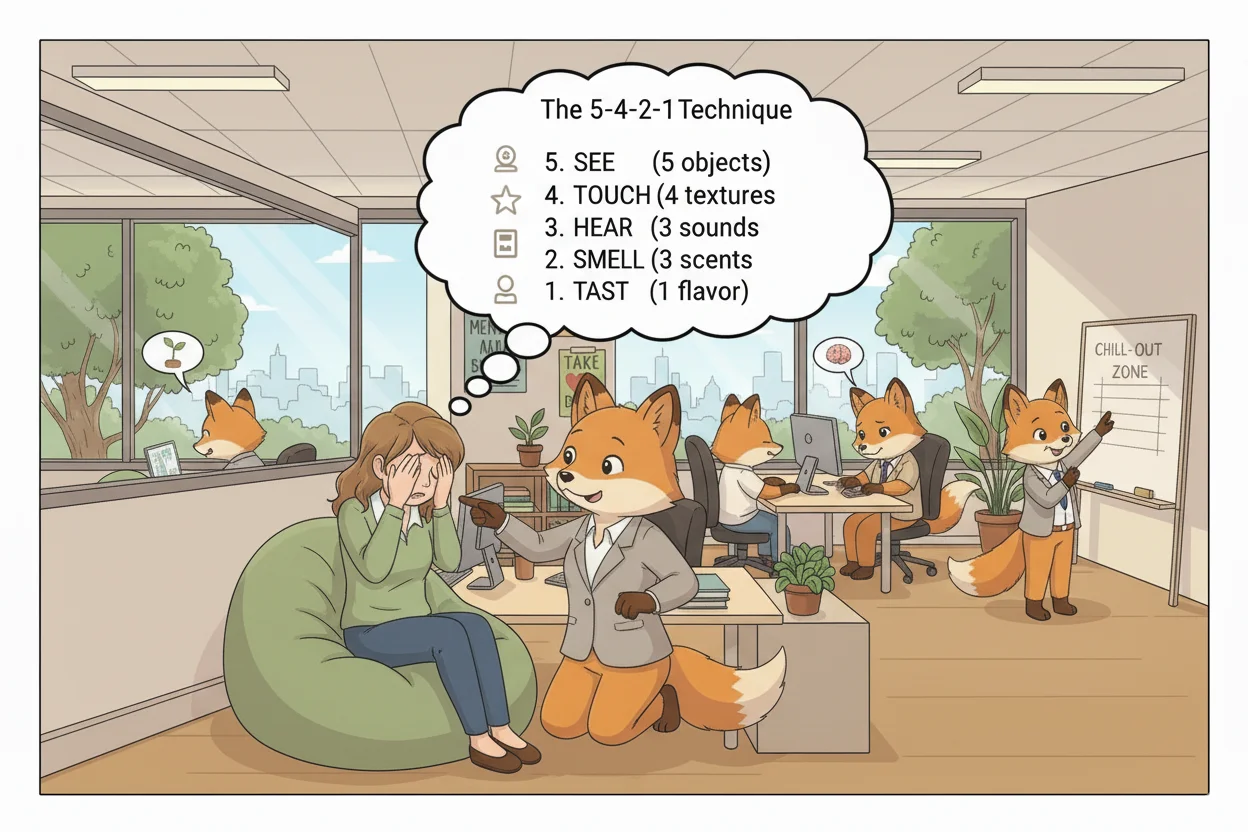
Try the 5-4-3-2-1 method:
- 5 things you can see
- 4 things you can touch
- 3 things you can hear
- 2 things you can smell
- 1 thing you can taste
Lifeline's panic support resources describe panic as something that can build, peak, and pass, and they encourage support, practical techniques, and professional help when needed. Grounding is not about doing a technique perfectly. It is about letting the room share some of your attention, so your thoughts are not the only thing in the space.
What your midnight self might be trying to tell you
Midnight burnout is painful, but it is also information.
Not a diagnosis.
Not a moral failure.
Information.
You might ask yourself, gently:
What did I push down today so I could get through it?
Do my worries get any space during daylight, or only in the dark?
If my body could speak, what would it say about the pace I have been keeping?
What is one thing I need to stop pretending is fine?
Do not turn this into a project tonight.
You are not here to conduct a full life audit at 2am.
Even acknowledging that midnight burnout is a signal, not a flaw, can be enough for now.
When this is more than a hard night
Some nights need more than an article.
If you feel like you might harm yourself, cannot stay safe tonight, or are thinking about ending your life, stop reading and reach for immediate support.
In Australia:
- Lifeline: call 13 11 14, text 0477 13 11 14, or visit lifeline.org.au.
- Beyond Blue: call 1300 22 4636 or visit beyondblue.org.au.
- Emergency services: call 000 if you or someone else is in immediate danger.
In the United States, call or text 988 for the Suicide and Crisis Lifeline.
If nighttime panic, insomnia, or anxiety keeps repeating, consider talking to a GP, therapist, psychologist, or another qualified professional. Cleveland Clinic notes that nocturnal panic attacks and panic disorder can be treated, including with therapy and medication when appropriate.
Sisi can support reflection and small stabilising steps. It is not crisis care, medical care, or a substitute for a real person when you are unsafe.
When you do not want to think this through alone
Some nights, reading steps and reflecting is enough.
On other nights, your mind is too tired to hold even that much.
Those are the nights when guidance can be kinder than more thinking.
7 Days to Breathe Again was built for that kind of hour. It does not ask you to become a different person. It offers a small guided reset before bed: breathing, grounding, and gentle prompts, so your midnight self has something to lean on instead of spiralling alone.
Start with one small win:
Tonight, I do not have to fix my whole life.
I only have to protect this hour.
For nights when you hold everything together in the daytime and need something to hold the hour with you.
Related Sisi guides
Turn this reading into Night Reset Script.
If this article is close to what is happening, start from the situation page. It gives one small win first, then routes into Breathe Again.
Start with: I can't sleep tonight