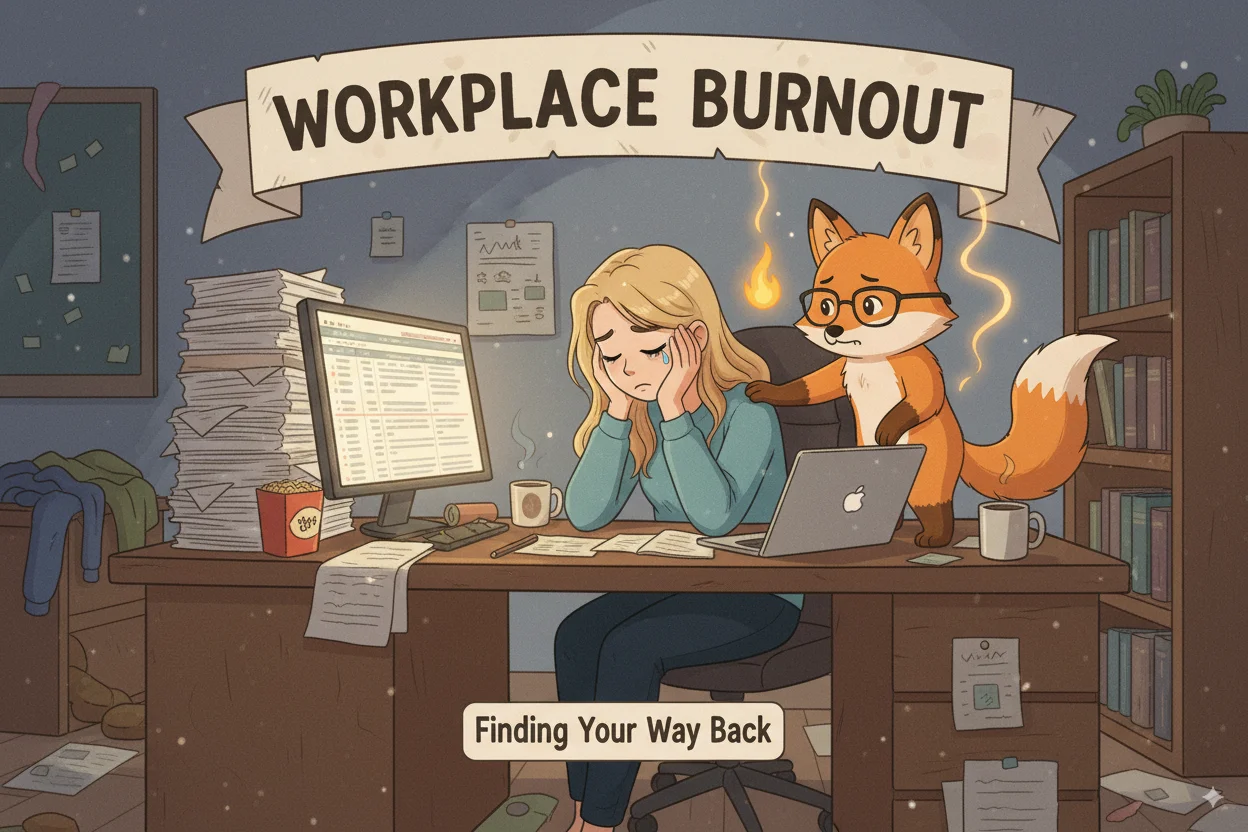
Burnout Recovery Takes Longer Than You Think: You Are Not Failing
If rest, weekends, or a holiday did not fix your burnout, it does not mean you are failing. It may mean your recovery expectations were too small for what your nervous system has been carrying.
You took the weekend off.
You slept more than usual. You answered fewer messages. Maybe you even took a holiday, booked the massage, deleted Slack for two days, or promised yourself that this time you would come back different.
Then Monday arrived.
Your chest tightened before you opened the laptop.
Your stomach dropped at one name in your inbox.
The smallest request felt like proof that nothing had changed.
And a second kind of pain appeared on top of the burnout:
Why am I still like this?
Why did rest not work?
Am I failing at recovery too?
Short answer: if you have been burning for months or years, it is not realistic to expect your body to recover in a weekend, a two-week break, or one clean decision. Burnout is linked to chronic workplace stress. Recovery often requires a slower reset of your nervous system, your workload, your boundaries, and sometimes the environment itself. The first goal is not to become your old self immediately. The first goal is to stop making tomorrow harder than today.
That is the part many burnout products skip.
They sell recovery as a deadline.
Your body does not recover on a product deadline.
What burnout actually is
The World Health Organization describes burn-out as an occupational phenomenon, not a medical condition. It is connected to chronic workplace stress that has not been successfully managed.
WHO describes three dimensions:
- energy depletion or exhaustion
- increased mental distance, cynicism, or negativity toward work
- reduced professional efficacy
Mayo Clinic also notes that job burnout can involve physical or emotional exhaustion, feeling powerless or empty, and effects on mental and physical health.
That matters because burnout is not simply "I need a nap."
It is often the result of a system repeatedly asking more from you than your body, identity, and circumstances can keep giving.
So when a weekend does not fix it, that does not mean you did the weekend wrong.
It may mean the injury is older than the break you gave it.
Why a holiday might not fix burnout
A holiday can help.
Sleep can help.
Time away can help.
But if you return to the same workload, same fear, same manager, same impossible expectations, same unpaid emotional labour, or same "just push through" culture, your nervous system may read the return as:
The threat is still here.
Stay braced.
This is why some people feel a small improvement during time off, then crash again when they return.
It is not because rest is useless.
It is because rest is only one variable.
The WHO mental health at work fact sheet names several workplace risks that can affect mental health, including excessive workloads, low control, long or inflexible hours, poor organizational culture, bullying, limited support, and job insecurity.
If those risks are still active, recovery has to include reality.
Not just breathing.
Not just gratitude.
Not just another productivity system.
Reality.
The recovery story people rarely say out loud
Here is a version of burnout recovery that does not fit neatly into a wellness ad.
Mira left the job that had been burning her for years.
At first, she thought leaving would feel like freedom.
For a few days, it did.
Then the exhaustion arrived properly.
Without the daily emergency of work, her body finally had room to show her what it had been holding. She slept, but did not feel restored. She opened her laptop to apply for new roles and felt her chest tighten. She tried to do gentle routines and still felt strangely flat.
Two months passed.
She was not "back".
And that became its own shame.
I left. I rested. Why am I still like this?
The turning point was not a perfect morning.
It was smaller.
One day she noticed that an email could wait until tomorrow and her whole body did not panic.
Another day, she cooked dinner without treating it like a productivity task.
Later, she realized she no longer cared about proving herself to the people who had kept moving the goalposts.
That was not a return to the old self.
It was a new equilibrium.
Not dramatic.
Not finished.
But real.
This is why "how long does burnout recovery take?" is often the wrong question. A better question is:
What would count as one small sign that my system is no longer in constant survival mode?
The expectation trap
Many burned-out people are not only exhausted.
They are ashamed of being exhausted.
They think:
- "I should be better by now."
- "Other people can handle this."
- "I rested. Why am I still tired?"
- "Maybe I am just weak."
- "Maybe I am not disciplined enough."
This is the expectation trap.
The original injury is burnout.
The second injury is believing your recovery speed proves your worth.
It does not.
Nothing is wrong with your recovery speed.
Your expectations may have been wrong.
A more honest recovery timeline
No article can tell you exactly how long your recovery will take. Burnout severity, health history, financial pressure, workplace culture, support, sleep, caregiving load, trauma history, and job security all matter.
But the shape is often less like:
Rest -> recover -> become old self again
and more like:
Stop adding damage -> lower the alarm -> regain small capacity -> test a new rhythm -> decide what has to change
People often expect:
Two quiet weeks should make me fine.
Reality may look more like:
The intensity drops first.
Then there are a few less-bad days.
Then one small pocket of curiosity returns.
Then you notice which conditions still make you shut down.
Then you realize you may not want the same old life back.
This is not failure.
It is how living systems often recover: unevenly, protectively, and in response to the environment around them.
You may not recover into the person who could tolerate everything.
You may recover into someone who can no longer ignore what the old version of you had to survive.
The question is not only "how do I recover?"
At some point, burnout asks a harder question:
Am I trying to recover inside the same system that exhausted me?
This is not a push to quit tomorrow.
Leaving can be financially risky. Staying can be psychologically costly. Both choices can be complicated, especially if you have rent, visa conditions, family pressure, health needs, or no safety net.
But if you only ask, "How do I recover faster?" you may miss the more important question:
What is still feeding the fire?
Examples:
- A manager who punishes boundaries.
- A workload that only works if you skip meals.
- A team culture where silence is called professionalism.
- A role where you have responsibility without authority.
- A workplace that calls chronic understaffing "resilience."
- A self-expectation that says you must be grateful even while you are breaking.
You may not need to quit today.
But you do need to see what is still burning.
Before you decide: stay, shift, or leave
Burnout can make every option feel extreme.
Stay forever.
Quit immediately.
Disappear.
Send the resignation email at midnight.
Say nothing and swallow another month.
Work Crossroads exists for the space before that irreversible move.
Not to tell you what to do.
To help you build enough evidence that you are not deciding from the worst hour.
The three options are:
Stay
Staying is not failure if it is conscious, bounded, and tied to a reason.
You might stay because:
- you need financial runway
- you are waiting for a contract, visa, or payout
- the issue is temporary and clearly time-limited
- there is a real manager, HR, union, or team pathway for change
- you can protect your health while preparing the next move
But staying by default is different.
If you are staying only because you are too tired to choose, that is evidence too.
Shift
Sometimes the question is not "leave or stay."
Sometimes it is:
- Can the workload change?
- Can the reporting line change?
- Can the schedule change?
- Can expectations be documented?
- Can one boundary be tested?
- Can one conversation reveal whether repair is possible?
Shift is the middle path many burned-out people forget exists.
It is also the path that gives you evidence.
If you ask for a reasonable change and the system punishes you for it, that tells you something.
Leave
Leaving may be the right move when the environment itself is the active harm.
Not because you are weak.
Because no nervous system can recover while the threat keeps being reintroduced.
Still, leaving deserves reality:
- What money do you need first?
- What support do you have?
- What records should you keep?
- What professional advice might you need?
- What is the safest timing?
- What would make leaving urgent?
The goal is not panic.
The goal is protection.
A 10-minute reality check
If you are reading this while exhausted, do not try to solve your whole career tonight.
Try this instead.
Take ten minutes and answer:
- What happened this week that made my body say "I cannot keep doing this"?
- What expectation is making me feel like I should already be fine?
- What is one thing still feeding the fire?
- What would make tomorrow slightly less damaging?
- Is the next safe move to stay, shift, pause, document, ask for support, or plan an exit?
Notice the wording.
Not:
How do I fix my whole life?
But:
What would stop tomorrow from being harder than today?
That smaller question is often where recovery begins.
When burnout overlaps with something more serious
Burnout language can be useful, but it should not become a way to avoid care.
If you are experiencing persistent hopelessness, thoughts of self-harm, panic that feels unmanageable, inability to function, severe insomnia, substance dependence, or fear that you cannot stay safe, please reach for immediate support.
In Australia:
- If life is in danger, call 000.
- Lifeline is available on 13 11 14.
- Beyond Blue provides mental health support on 1300 22 4636.
This article is reflective education and practical support. It is not medical, legal, HR, or financial advice. A GP, psychologist, counsellor, union representative, employment lawyer, or qualified workplace professional may be the right support depending on your situation.
Where Work Crossroads fits
Work Crossroads is not a burnout cure.
It does not promise that fourteen missions will undo years of exhaustion.
It does one more honest thing:
It helps you stop feeding the fire long enough to build a Stay / Shift / Leave Brief.
Inside the lab, you start from the live situation:
- "I want to quit tomorrow."
- "I cannot face Monday."
- "I am burned out, and scared I am recovering too slowly."
- "I do not know if it is me or the workplace."
Then you collect evidence:
- what happened
- what your body is signalling
- what expectations are hurting you
- what boundary keeps failing
- what can be repaired
- what cannot keep being swallowed
You leave with an artifact, not a motivational speech.
Your brief may not tell you the final answer forever.
It should tell you the next safer move.
Start the 10-minute Work Crossroads reality check
Related reading
- Midnight Burnout: When You Hold It Together All Day and Fall Apart at Night
- Sunday Scaries: Why You Dread Monday
- Job Loss / Career Reset: When the Search Has Stalled
- Panic at Night? What to Do When Everything Feels Too Loud
Final thought
You are not behind.
Your nervous system is recovering at the speed living systems recover.
Maybe the next step is rest.
Maybe it is documentation.
Maybe it is one boundary.
Maybe it is asking for help.
Maybe it is admitting that the problem is not your recovery speed, but the system you keep being asked to recover inside.
Either way, you do not have to decide from shame.
Start with relief.
Then evidence.
Then one safer move.
Turn this reading into Stay / Shift / Leave Brief.
If this article is close to what is happening, start from the situation page. It gives one small win first, then routes into Work Crossroads.
Start with: Should I quit my job
