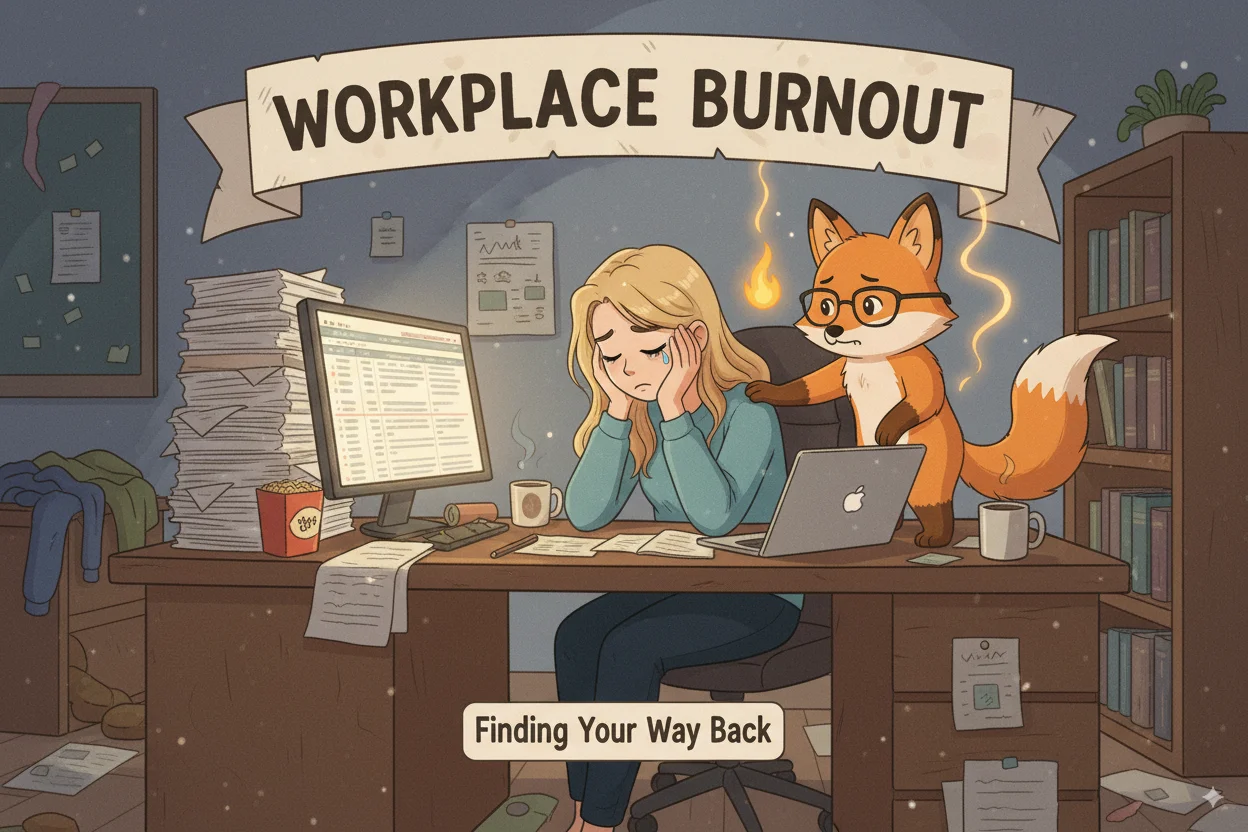
What to Do After Burnout: When You Can Still Work, But Not Like This Anymore
If you can still work but cannot keep working like this, the next step may not be quitting everything. It may be finding whether you need to reduce, reroute, or exit.
Burnout does not always end with slamming your laptop shut and quitting on the spot.
For many people in tech, startups, agencies, and knowledge work, it ends with something quieter and more confusing:
I can still work.
I just cannot work like this anymore.
You still care about your craft. You still want to earn a living. You might even enjoy parts of the work.
But the way your role, team, company, or industry currently asks you to work feels like too much for your nervous system to safely carry.
This page is for that in-between moment.
Not:
How do I recover so I can hustle harder again?
But:
What kind of work can I actually live with now?
And what needs to change before I break myself again?
Short answer: after burnout, the next move is not always "quit everything" or "push through". A safer first step is to separate three possibilities: reduce the pressure, reroute into a better work container, or exit a system that is no longer compatible with your health. You do not need a perfect life plan today. You need evidence about what your body, work, and current life can realistically hold.
You may not need to leave your craft
It is tempting to frame burnout as a binary:
Stay in the industry and suffer.
Or leave the industry and finally heal.
Sometimes leaving really is the safest move.
But sometimes the problem is not the craft itself. It is the pressure system around it.
The World Health Organization describes burn-out as an occupational phenomenon linked to chronic workplace stress that has not been successfully managed. The WHO mental health at work fact sheet also names workplace risks such as excessive workloads, low job control, long or inflexible hours, poor organizational culture, limited support, unclear roles, bullying, job insecurity, and conflicting home and work demands.
That list matters because it points away from one cruel conclusion:
Maybe I am just not strong enough.
And toward a more useful question:
Which part of the work system is making this unsafe to carry?
You may not need to leave tech, design, product, writing, operations, research, teaching, care work, or leadership.
You may need to leave:
- constant firefighting
- unpaid emotional labour
- unclear ownership
- 24/7 availability
- high-stakes work with no recovery time
- a manager or culture that turns every mistake into identity damage
- a prestige game that no longer fits your actual life
The difference matters.
If you love the craft but hate the container, the next move may be reroute, not abandon.
Burnout is not always too much work
We often talk about burnout as "too many hours" or "too much work".
That can be true.
But burnout can also come from something more specific:
too much effort with too little return
Not only financial return.
Also:
- respect
- control
- meaning
- learning
- recovery
- trust
- a life outside the job
PMAC's overview of burnout in the tech industry points to high-pressure environments, long hours, tight deadlines, constant learning demands, performance tracking, multiple projects, unclear goals, and difficulty switching off. Those are not just "busy work" problems. They are conditions where effort can keep rising while reward, control, and recovery keep shrinking.
That is why a person can burn out while working enormous hours.
And another person can burn out while sitting in a role that looks quiet from the outside but feels meaningless, underused, watched, or trapped.
The question is not only:
How much am I doing?
It is also:
What does this effort return?
And is the return still worth the cost?
If the answer is "almost nothing", rest alone may not be enough.
Your system may be asking for a different bargain.
Your life season may have changed
Sometimes burnout feels confusing because the job did not change much.
The calendar looks similar. The meetings look similar. The role looks similar.
But you changed.
You may have taken this work on when you were:
- younger
- healthier
- child-free
- less financially stretched
- less responsible for other people
- more willing to trade nights and weekends for career momentum
Now your life may include a baby, caregiving, grief, chronic stress, immigration pressure, family needs, health issues, or a simple truth: you do not want your life to orbit work in the same way anymore.
That does not mean your ambition disappeared.
It means the old work strategy may no longer fit the life you actually have.
This is one of the most important post-burnout questions:
Am I trying to force an old work strategy onto a new life season?
If the answer is yes, the problem is not only motivation.
The problem is mismatch.
You may still be capable. You may still be skilled. You may still care.
But the role may require a version of you who no longer exists, or no longer deserves to be sacrificed.
The question is not only "Should I quit?"
After burnout, "Should I quit?" is often the loudest question.
It is rarely the best first question.
Try these instead:
- What pace of work can my nervous system sustain now?
- Which tasks still feel meaningful, and which feel like extraction?
- What kind of responsibility is safe for this season?
- Which boundaries would have to be real, not theoretical?
- What kind of team, manager, or company would make this craft livable again?
- What do I need to stop pretending I can carry?
Those questions are less dramatic than "Should I quit?"
They are also more useful.
Because "quit" is one action.
But burnout usually asks for a whole new operating agreement between your work and your life.
Three safer moves: reduce, reroute, or exit
After burnout, a safer decision usually lives in one of three routes.
Not all routes are equal for every person.
The point is to stop treating your only options as:
Stay exactly as it is.
Or blow everything up.
There is more room than that.
1. Reduce: lower the pressure before changing the whole life
Reduce means the role might still be workable if the pressure changes.
That could mean:
- fewer concurrent projects
- clearer ownership
- no after-hours messages except true emergencies
- fewer meetings
- a temporary reduction in hours
- a different on-call rotation
- a written agreement about scope
- one boundary that is finally treated as real
The WHO mental health at work guidance discusses workplace-level interventions such as flexible working arrangements, reasonable accommodations, modified assignments, and supportive manager practices. That matters because burnout is not only an individual self-care issue. Sometimes the work design itself has to change.
Reduce is not:
I failed, so I need less.
Reduce is:
This system needs a lower pressure setting if I am going to stay human inside it.
Try writing:
If I stayed for the next 30 days, the one condition that would have to change is...
If you cannot name a condition, staying may stay vague.
If you can name one and nobody will even discuss it, that is evidence too.
2. Reroute: keep the skill, change the container
Reroute means the craft may still belong in your life, but this container does not.
The container might be:
- the team
- the manager
- the company stage
- the sector
- the pace
- the on-call load
- the visibility level
- the prestige bargain
For example:
- You may still like software, but not startup incident pressure.
- You may still like strategy, but not constant executive firefighting.
- You may still like leadership, but not being the emotional shock absorber for a broken organization.
- You may still like deep work, but not a role built entirely around interruption.
Reroute is especially important for capable people who think:
If I cannot do this version of the work, maybe I cannot do the work at all.
That is often not true.
It may be that your nervous system is not rejecting the craft.
It may be rejecting the container.
Try writing:
Where else could this skill live with less damage?
Name three places.
Not perfect places. Just different containers.
3. Exit: when the cost is too high to keep absorbing
Exit means the current role, environment, or work pattern may no longer be compatible with your health, family, identity, or future.
This is not a failure.
It is a safety decision.
Exit may be worth taking seriously if:
- your body reacts before work even starts
- your sleep, appetite, mood, or relationships are deteriorating
- you have tried reasonable boundaries and nothing changes
- the culture punishes honesty
- your health professional is concerned
- you are becoming someone you do not recognize
- the job keeps asking for a version of you that your life can no longer afford
The Black Dog Institute notes that burnout can require taking symptoms seriously, seeking support, and looking at the work and life factors contributing to the strain.
That is the key: look at the factors.
Not only your attitude.
Not only your resilience.
Not only your sleep routine.
The factors.
If the factors keep burning you, exit may be the most honest route.
Before you resign, build a brief
Big decisions become more dangerous when they live only inside the worst hour of the week.
That is why Sisi uses a simple artifact:
Stay / Shift / Leave Brief
It is not a personality test.
It is not a prediction.
It is not a motivational worksheet that tells you to believe harder.
It is a record of evidence before action.
Stay: under what conditions?
If you were to stay, what would have to change for it to be safe?
Write down:
- the workload condition
- the boundary condition
- the support condition
- the review date
- the consequence if nothing changes
Example:
I can stay for 30 days if on-call expectations are clarified, weekend work stops unless truly urgent, and my manager agrees to a weekly scope review.
This is not about making a wish.
It is about turning "maybe it will get better" into a testable condition.
Shift: what container might fit better?
If you were to shift, what could change before you leave the whole field?
Write down:
- one team shift
- one role shift
- one company-stage shift
- one sector or pace shift
- one lower-pressure version of the same skill
Example:
I may not need to leave engineering. I may need to leave incident-heavy startup engineering and test internal tools, developer education, or a more stable product team.
Shift protects you from one common burnout mistake:
This container hurt me, so the whole craft must be wrong for me.
Maybe.
But gather evidence first.
Leave: what would make exit safe enough?
If you were to leave, what would you need in place?
Write down:
- financial runway
- health support
- legal or HR advice if needed
- who knows what is happening
- what you will not accept next
- what kind of rest or reset you actually need before the next role
Example:
I can leave safely if I have three months of runway, one professional adviser, a basic job search plan, and a rule that I will not take another high-urgency role as my immediate escape hatch.
Exit is not only a resignation letter.
It is a protection plan.
Why this brief matters
Burnout often takes away a person's sense of control.
Everything starts to feel like reaction:
React to the email.
React to the meeting.
React to the deadline.
React to the fear.
React to the Sunday night dread.
A brief gives you one place where you do not have to react.
You can look.
You can name.
You can separate.
You can ask:
Is this a reduce problem?
Is this a reroute problem?
Or is this an exit problem?
That question is not small.
It can change the whole shape of the decision.
Where Work Crossroads fits in
If you are reading this while still employed and thinking:
I am not ready to make a huge move.
I just know I cannot keep working like this.
That is exactly where Work Crossroads sits.
It does not promise that burnout will disappear in fourteen days.
It does not tell you to stay.
It does not tell you to quit.
It helps you build evidence for a safer decision:
- what is actually happening
- what your body is showing you
- what effort no longer returns enough
- what boundary keeps failing
- what work container may fit better
- what your current life season can actually carry
- what one reversible move you can test next
By the end, you are not meant to have a perfect life answer.
You are meant to have a brief.
Something you can open before the resignation email.
Something you can bring into a boundary conversation.
Something you can use before choosing the next role from urgency.
You do not have to know yet whether you will reduce, reroute, or exit.
You do deserve to stop burning alone while you figure it out.
Related reading
Turn this reading into Stay / Shift / Leave Brief.
If this article is close to what is happening, start from the situation page. It gives one small win first, then routes into Work Crossroads.
Start with: Should I quit my job